
The botanical truth test: how to know if an essential oil is pure
A pure essential oil declares its Latin botanical name, origin, plant part, and extraction method on its label, comes in dark glass, and has a price consistent with its raw material. The only conclusive proof is a gas chromatography analysis of the batch, which any serious brand should be able to provide.
On a shelf, an authentic lavender oil and one diluted with solvent look identical. Same amber bottle, same dropper, the same word "pure" printed in the same typeface. The difference is inside, in a chemistry that the eye cannot see and the trained nose can barely intuit. This guide gathers the signs you can read on your own, the home tests that are worth doing, those circulating on the internet without foundation, and the document that resolves any doubt.
Why are there so many adulterated essential oils?
Because producing them is slow and costly. Obtaining a kilo of rose oil requires several tons of hand-harvested petals, and vetiver root spends many hours in the still before yielding its oil. When demand grows faster than harvests, the temptation to stretch the product appears, and in a market with little regulation, that temptation becomes common practice.
The most frequent adulterations follow four patterns. Dilution mixes the oil with a cheap vegetable oil or with solvents like dipropylene glycol or alcohol. Reinforcement adds synthetic molecules identical to natural ones, such as laboratory linalool in a weak lavender, to make the aroma seem more intense. Substitution sells a cheaper species under the name of another, such as lavandin presented as lavender or amyris presented as sandalwood. And mixing origins combines batches from various countries without declaring it, which erases any traceability.
What should the label of a pure essential oil say?
| A reliable label shows | Warning sign |
|---|---|
| Full botanical name, such as Lavandula angustifolia | Only the common name, such as "lavender oil" |
| Country or region of origin | "Imported" or no origin |
| Part of the plant distilled | No mention of the part used |
| Extraction method | No mention of the method |
| Batch number | No batch or date |
| Amber or dark blue glass bottle with dropper | Plastic or clear glass |
| Different price according to the plant | The same price for all the brand's oils |
This last point says a lot. A brand that sells vetiver, eucalyptus, and lemon at the same price is ignoring the fact that the cost of their raw materials is radically different, and that rarely happens with pure products.
Home tests: which ones work and which are myths
The paper test
Put a drop on a white piece of paper and let it dry for several hours. Light essential oils, such as peppermint, eucalyptus, or lavender, evaporate almost completely. If a persistent greasy spot remains, it is most likely that the oil is diluted in a vegetable oil. The test has a clear limit, because dense oils like vetiver, patchouli, or ylang ylang leave a natural mark due to their own composition, and cold-pressed citrus oils can leave a slight residue of waxes. It serves as an indication for light oils and nothing more.
The nose test
A natural essential oil evolves. It opens in one way, transforms over the following minutes, and leaves a different base at the end, as we describe in the olfactory pyramid. A flat aroma, identical from the first second to the last, or an initial hit that recalls alcohol, are signs of solvent or synthetic composition. This test depends on experience and improves greatly if you have a reliable reference oil to compare.
The myths
The freezer test proves nothing. Some pure oils solidify in the cold and others do not, depending on their chemistry, so the result does not indicate purity. The expression "therapeutic grade" is a commercial denomination created by brands, without any official standard to support it. The "100% natural" label also guarantees nothing if it is not accompanied by the botanical name and the origin. And a high price on its own does not prove authenticity, because adulteration is also sold at high prices.
The conclusive test: gas chromatography
Gas chromatography with mass spectrometry, known as GC-MS, separates an oil into each of its molecules and measures the proportion of each. It is the batch's fingerprint. With that report, the oil can be compared against the ranges that each species should have, and there are international standards that define them, such as ISO 3515 for lavender oil.
Reading it does not require being a chemist. In an authentic lavender, linalool and linalyl acetate should dominate the profile; if a high proportion of camphor appears, it is likely that it is lavandin. In a globulus eucalyptus, 1,8-cineole should be the main component. And if the report shows molecules that do not exist in the plant, such as certain solvents or synthetic compounds, the adulteration becomes evident.
The document that summarizes these results is called a certificate of analysis (COA). A brand that works with traceable raw materials can provide it, or at least confirm that it exists for each batch.
How to verify an essential oil before buying it
- Look for the Latin botanical name on the label or product sheet.
- Confirm the origin, ideally with region and not just country.
- Check the part of the plant and the extraction method, and verify that they make sense (citrus is cold-pressed, roots and woods are distilled).
- Observe the packaging and price, dark glass with dropper and prices differentiated by plant.
- Ask for the batch number and the certificate of analysis. A clear response is the best sign of all.
Signs of purity in the most common oils
Each plant has its typical adulteration, and knowing it helps to know what to check on the label and what to ask the supplier.
Peppermint
The most frequent substitution is wild mint, Mentha arvensis, a cheaper species that the industry uses to extract menthol. Authentic Mentha × piperita has a rounder, sweeter profile, and in chromatography, menthofuran appears, a molecule that wild mint hardly has. If the label says only "peppermint oil," without the botanical name, there is no way to know which of the two you are buying.
Lavender
The main risk is receiving lavandin, a higher-yielding hybrid, or a weak lavender reinforced with synthetic linalool and linalyl acetate. Lavandin has more camphor and a sharper, almost medicinal profile, while Lavandula angustifolia is soft and floral.
Eucalyptus
Under the name eucalyptus, oils from various species and rectified mixtures are sold. In an authentic Eucalyptus globulus, 1,8-cineole is the dominant component, and the label should declare the species and the origin.
Lemon and bergamot
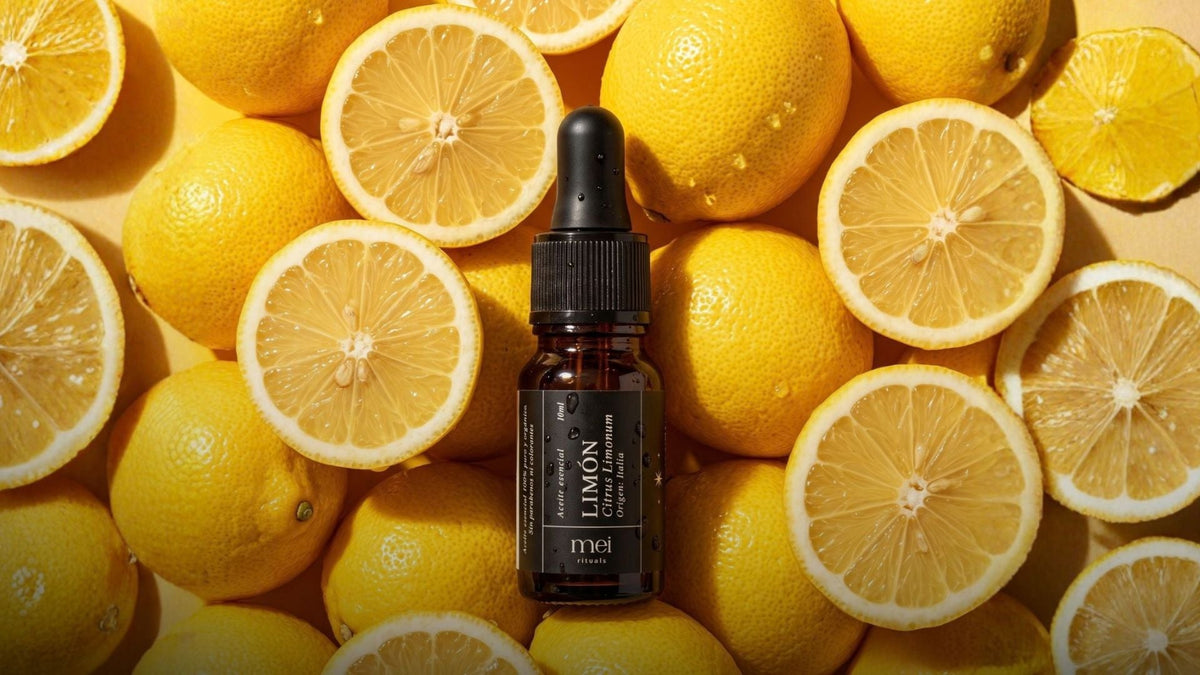
Citrus oils are stretched with orange terpenes, a cheap byproduct of the juice industry, or with synthetic citral. In bergamot, there is an additional nuance, because there are versions without bergapten (called FCF) that are safer on the skin. They are legitimate, but the label must indicate it.
Palo Santo
The name is shared between Bursera graveolens from Ecuador and Peru and Bulnesia sarmientoi from the Gran Chaco, two trees with very different aromas. We explain it in detail in the chronicle of Ecuadorian Palo Santo.
How we do it at Mei
Each Botánica Pura oil declares its Latin binomial, its geographical origin, its extraction method, and its purity grade, and comes from a specific terroir instead of a mixture of suppliers. When an origin is not verified with the supplier, we prefer not to write it down. The complete file of the twelve botanicals is in our single-origin essential oils guide.
Frequently asked questions
What does it mean for an essential oil to be therapeutic grade?
Nothing verifiable. It is a marketing term created by private brands and does not correspond to any official standard or independent certification. To evaluate quality, the botanical name, origin, extraction method, and batch chromatography analysis matter.
How much does a pure essential oil cost?
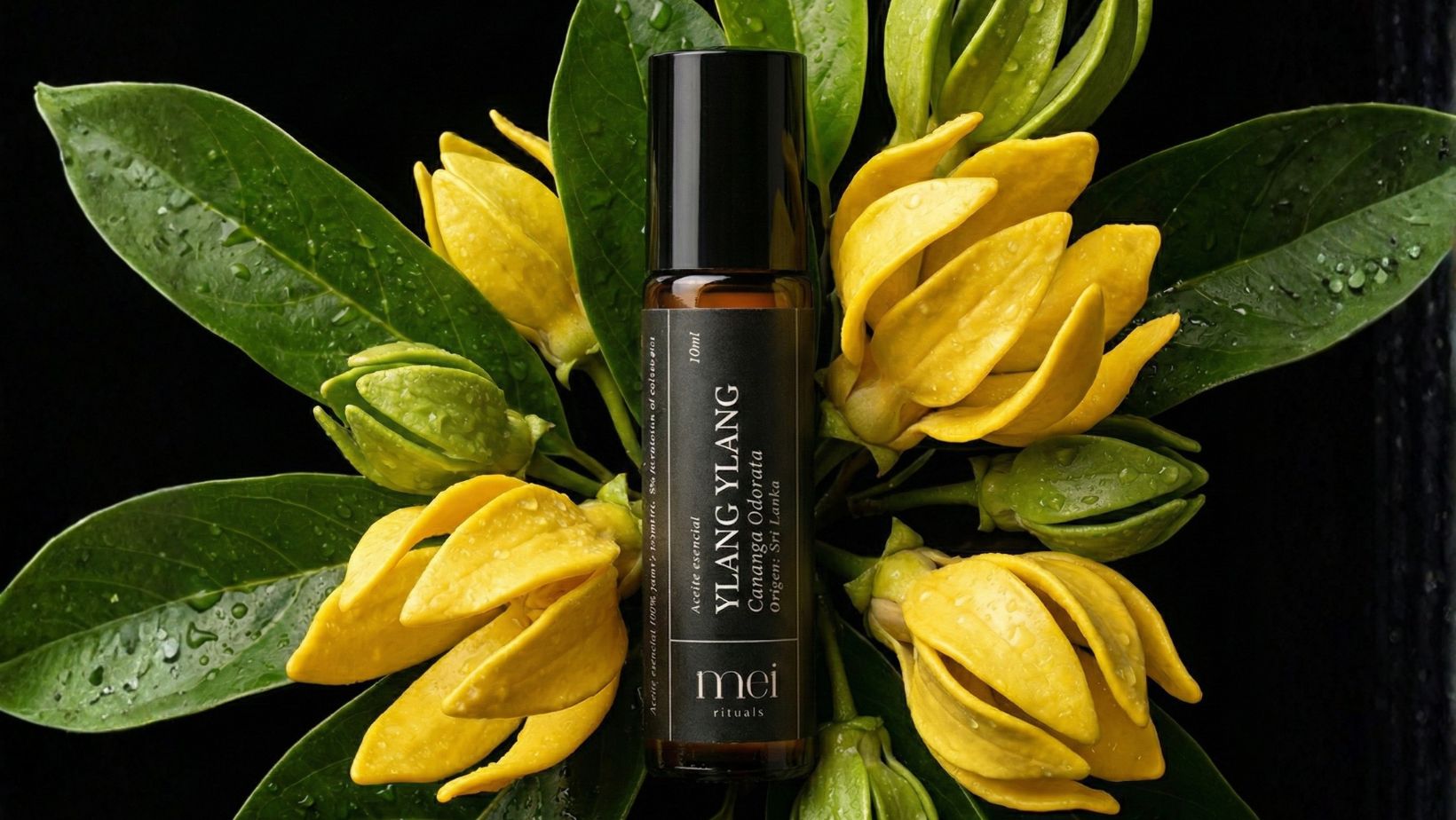
It depends on the plant and how much oil its distillation yields. Citrus and leaves, such as lemon, peppermint, or eucalyptus, yield a lot and are usually the most affordable, while roots, woods, and some flowers, such as vetiver, sandalwood, or rose, are costly by nature. As a reference, at Mei a 10 ml bottle costs 50,000 pesos for lavender, peppermint, eucalyptus, rosemary, lemongrass, lemon, bergamot, and ylang ylang, and 55,000 pesos for vetiver, cedar, palo santo, and patchouli. A very low price for a root or a wood is a sign of dilution or substitution.
Why do two oils from the same plant smell different?
Due to the origin, the harvest, and the extraction method. Soil, altitude, and climate change the proportion of molecules within the same species, and in some plants like rosemary, there are chemotypes with very different profiles. It can also be a sign that one of the two is adulterated.
Are synthetic aromatic oils bad?
They have their place in perfumery and ambient products, and when well formulated, they are safe. The problem arises when a synthetic or mixed oil is sold as pure essential oil. Transparency on the label is what allows you to choose with information.
What the label leaves unsaid
A pure essential oil is the plant reduced to its most concentrated expression, with a place of origin and a chemistry that can be traced. Asking for that traceability from any brand, starting with our own, is the simplest way to know what you are letting into the air of your home.