
Article: Single-origin essential oils, the Bitácora guide
Single-origin essential oils, the Bitácora guide
An essential oil is the volatile, aromatic extract of a plant, obtained by steam distillation or cold pressing a specific part of it, whether a flower, leaf, root, wood, or peel. Its chemical composition depends on the species, the part used, and the place where it grew, which is why the origin defines the olfactory profile of each bottle.
Ten milliliters of lavender contain the work of an entire field. Behind every drop is a latitude, a soil, a sunny season, and a decision about which part of the plant to cut and how to distill it. This guide gathers what we have learned while traveling through twelve origins, from the roots of Sri Lanka to the peels of Calabria, and serves as a map to read any essential oil before letting it into your home.
What exactly is an essential oil?
The name is confusing. It is called an oil because it does not mix with water, although chemically it has very little in common with olive or almond oil. Vegetable oils are heavy fats that do not evaporate; an essential oil is a mixture of dozens or hundreds of small, volatile molecules, mainly terpenes, alcohols, esters, and aldehydes, which the plant produces to defend itself against insects, attract pollinators, or protect itself from the sun. That volatility is what allows the aroma to travel through the air in a room.
It is also an extremely concentrated material. It takes kilos of flowers, leaves, or wood to obtain a few milliliters, which is why a single drop is enough to change the atmosphere of a space. That concentration explains its potency and also the caution that should be taken when using them on the skin.
How is an essential oil extracted?
Most are obtained by steam distillation. Steam passes through the plant material, carries the aromatic molecules, and, upon cooling, separates into two phases: the floral water (hydrolat) and the essential oil that floats on top. This is how lavender, vetiver, cedar, eucalyptus, and patchouli are distilled.
Citrus fruits follow a different path. Bergamot and lemon are obtained by cold pressing, mechanically squeezing the peel without heat, because the fresh molecules of their top notes would degrade with temperature.
Some flowers require more patience. Ylang ylang is distilled in a fractionated way, collecting the oil in successive stages over several hours, with each fraction having a different intensity and texture. There are also absolutes, extracted with solvents from flowers too delicate for steam, such as jasmine, although they technically belong to another category.
Why does the origin change an essential oil?
Two plants of the same species can produce very different oils depending on where they grow. Altitude, temperature, solar radiation, soil type, and the time of harvest modify the proportion of each molecule. In perfumery, this is known as terroir, the same concept used for wine.
Lavender is the clearest example. Lavandula angustifolia grown at high altitude, such as that from Haute Provence, usually develops more esters, particularly linalyl acetate, which gives it a softer, more floral profile than lowland lavender. Rosemary goes even further, because the same species has different chemotypes depending on the region—some rich in camphor and others in 1,8-cineole—with olfactory profiles that barely resemble each other.
That is why at Mei we work with single-origin products. Each oil comes from a specific terroir and declares its provenance, rather than mixing batches from different countries to cut costs. A single-origin oil is traceable, and that traceability is what allows you to know what you are smelling.
Types of essential oils based on the plant part
The most useful way to categorize essential oils is by the part of the plant they come from, because that part anticipates how they behave in the air and the place they occupy in the olfactory pyramid.
Peels. Bergamot and lemon. They are the most volatile, open with brightness, and dissipate quickly. They function as top notes.
Leaves and herbs. Eucalyptus, mint, rosemary, lemongrass, and patchouli. They have a green, fresh, or herbal profile with medium longevity, except for patchouli, which acts as a base note due to its density.
Flowers. Lavender and ylang ylang. They provide the body of the aroma and occupy the heart of a composition.
Roots. Vetiver. It is the heaviest and slowest material, with a longevity that can last for hours on fabric.
Woods. Cedar and palo santo. Dry, resinous, and stable, they provide structure and weight to a space.
Mei's twelve botanicals, profile by profile
| Oil | Botanical name | Origin | Distilled part | Method | Main compounds | Character at home | Profile |
|---|---|---|---|---|---|---|---|
| Lavender | Lavandula angustifolia | Haute Provence, France | Flowering tops | Steam distillation | Linalool, linalyl acetate | Rest | View oil |
| Vetiver | Chrysopogon zizanioides | Sri Lanka | Root | Steam distillation | Khusimol, vetivones | Deep rest | View oil |
| Patchouli | Pogostemon cablin | Papua New Guinea | Dried leaves | Steam distillation | Patchoulol, bulnesene | Depth | View oil |
| Atlas Cedar | Cedrus atlantica | Atlas Mountains, North Africa (processed in Australia) | Wood | Steam distillation | Himachalenes, atlantones | Calm with weight | View oil |
| Palo Santo | Bursera graveolens | Ecuador | Fallen wood | Steam distillation | Limonene, α-terpineol, menthofuran | Calm with weight | View oil |
| Eucalyptus | Eucalyptus globulus | India | Leaves | Steam distillation | 1,8-cineole | Clean air | View oil |
| Mint | Mentha × piperita | India | Leaves | Steam distillation | Menthol, menthone | Focus | View oil |
| Rosemary | Rosmarinus officinalis | Spain | Leaves and twigs | Steam distillation | Camphor, 1,8-cineole, α-pinene | Focus | View oil |
| Lemongrass | Cymbopogon flexuosus | Kerala, India | Leaves | Steam distillation | Citral (geranial and neral) | Light | View oil |
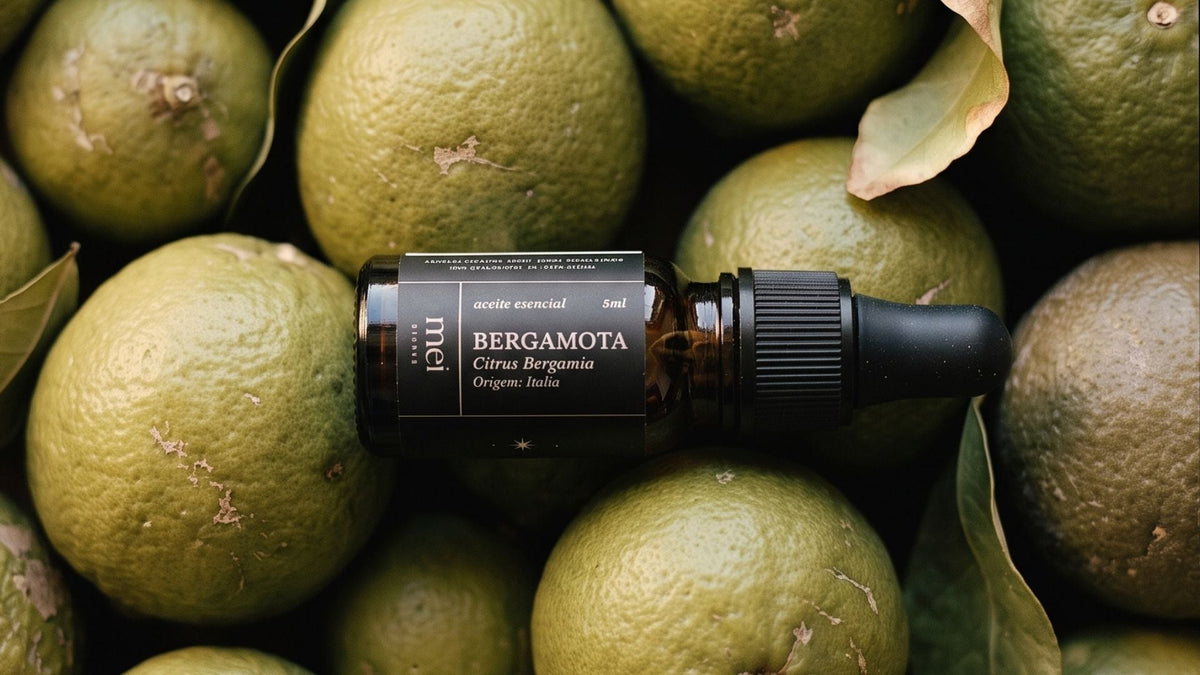
| Bergamot | Citrus bergamia | Calabria, Italy | Peel | Cold expression | Limonene, linalyl acetate | Light | View oil |
| Lemon | Citrus limon | Sicily, Italy | Peel | Cold expression | Limonene, β-pinene | Focus | View oil |
| Ylang Ylang | Cananga odorata | Mayotte | Flowers | Fractionated distillation | Linalool, germacrene D, benzyl acetate | Warmth | View oil |
Each name links to its chronicle in the Journal, where we tell the origin of that plant in more detail, and the last column leads to its profile in Pure Botany, with price and presentation.
What are essential oils for at home?
At Mei, we understand the essential oil as a tool for air design. Each aromatic family accompanies a different state, and assigning them with intention to each space is the foundation of Olfactory Zoning.
For rest, lavender and vetiver are bedroom allies at the end of the day, one for its floral softness and the other for its earthy density. For focus, mint, rosemary, and lemon work well in the study or home office, because their freshness is sharp and clear. For calm with weight, cedar and palo santo provide structure to living rooms and reading areas. And for light, bergamot and lemongrass bring clarity to kitchens and transition areas.
Aromas accompany moods and rituals. They do not replace any medical treatment, and any use for health purposes should be consulted with a professional.
How to use an essential oil?
In an ultrasonic diffuser, between five and eight drops in the reservoir water, in thirty-minute cycles. It is better to diffuse at intervals than to leave the equipment on all afternoon, because the sense of smell habituates and stops perceiving the aroma.
On textiles, two drops on the pillow hem or a corner of a blanket, away from direct contact with the face.
In the shower, three drops on the wall before turning on the hot water. The steam disperses the aroma immediately—an especially good resource with eucalyptus or mint in the morning.
On the skin, never pure. An essential oil must be diluted in a carrier oil, such as almond or jojoba oil, and it is advisable to first do a patch test on a small area. Bergamot contains bergapten, a photosensitizing molecule, so it should not be applied to skin that will be exposed to the sun. In homes with cats, babies, or pregnant women, it is advisable to diffuse in moderation in ventilated spaces and consult before using any oil for a prolonged period. Essential oils should not be ingested.
How to choose a good essential oil?
A serious label always declares the botanical name in Latin, the country or region of origin, the part of the plant, and the extraction method. If a bottle only says "lavender oil," there is no way to know if it is Lavandula angustifolia, lavandin, or a synthetic fragrance. The packaging should be dark amber or blue glass, because light degrades the compounds, and the price should be consistent with the raw material, since a vetiver or sandalwood can never cost the same as an orange.
We have prepared a specific guide on how to know if an essential oil is pure, with home tests that work, those that are myths, and the documents you should ask from any brand.
Essential oils in Colombia's climate
Temperature changes how an oil behaves in the air. In the cold of Bogotá, at more than 2,600 meters, molecules evaporate more slowly and the aroma takes longer to fill the room, so it may be advisable to add one or two drops to the diffuser or extend the cycle. In the heat of the coast, the opposite happens: citrus notes dissipate quickly, and woods and roots perform better. The temperate climate of Medellín is the middle ground, where usual doses work without adjustments.
Heat also accelerates oxidation. In any city, keep the bottles tightly closed, away from windows and the kitchen. Citrus oils are the most sensitive and should be used within one or two years after opening, while vetiver, patchouli, and woods age more stably and even gain depth over time.
Frequently asked questions
Do essential oils expire?
Yes, they oxidize with air, light, and heat. Citrus oils last between one and two years after opening; flowers and herbs, between two and three; roots and woods can be kept in good condition for several years if kept closed and in an amber bottle.
Can an essential oil be applied directly to the skin?
No. They must be diluted in a carrier oil, such as almond or jojoba, and tested first on a small area. Cold-pressed citrus oils, such as bergamot, can cause reactions with sun exposure.
What is the difference between an essential oil and an aromatic oil?
An essential oil is obtained directly from the plant by distillation or expression. An aromatic or fragrance oil is usually a totally or partially synthetic composition designed to mimic a scent and does not have the chemical complexity or botanical traceability of an essential oil.
How many drops of essential oil go in a diffuser?
Between five and eight drops in a standard ultrasonic diffuser, in cycles of about thirty minutes. In large spaces or in cold weather, the dose can be increased slightly.
Which essential oil is best for sleeping?
Lavender (Lavandula angustifolia) and vetiver are the most used in the bedroom. Lavender provides a soft floral profile and vetiver an earthy and dense base; combined in the diffuser half an hour before going to bed, they create an atmosphere of rest.
Where to buy pure essential oils in Colombia?
It is best to buy from brands that declare the botanical name, origin, part of the plant, and extraction method on each bottle, and that can provide batch information. At Mei, the twelve oils of Pure Botany come in 10 ml amber glass bottles, each from a single origin, with shipping throughout Colombia.
The complete map
Each bottle in this guide holds a specific place in the world, and knowing that place changes how you inhabit it. Choosing an essential oil by its origin is consciously choosing what enters the air you breathe every day, and that small gesture is where the design of a sanctuary begins.